Live stream: london_stave_hill.mp3
Stave Hill Ecological Park, Rotherhithe, London
Soundcamp, Stave Hill / TCV
Latitude: +51.502316290495585°
Longitude: -0.040172948049244095°
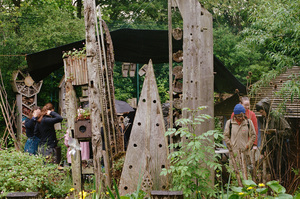
The Stave Hill soundcamp takes place in one of the UK's first urban ecology parks, a collection of micro habitats co-created between human and natural agencies since 1986. It serves as a hub for the Reveil daybreak broadcast and hosts a free public programme of walks, talks and workshops over the Dawn Chorus Day weekend (2 to 3 May 2026). This 13th iteration isi produced by the soundcamp cooperative in partnership with Stave Hill / TCV. For details on visiting and/or camping out, please see soundtent.org or mail contact@soundtent.org.
Operated by Soundcamp with support from TCV, Southwark Neighbourhoods Fund.
A long-term live stream from a vegetated lean-to roof in Rotherhithe, South London, relays a dense and varied overlay of sounds from omnidirectional stereo microphones. The streaming device enables ‘flat remote listening’ which brings the topologies of places together in unexpected ways.
Stave Hill Ecological Park was created in 1986 from rubble infill into abandoned wet docks. It is the successor to the William Curtis Ecological Park, the UK's first urban ecology park, set up in 1977 near Tower Bridge by the Trust for Urban Ecology. It has been managed for over 30 years by Rebeka Clark, (TRUE) and the Trust for Conservation Volunteers (TCV). Since 2014, it has hosted the annual Soundcamp festival of art and ecology. It acquired ‘local nature reserve’ status in 2017.
Co-created by human and non human agencies, the site has become a biodiversity hotspot and a key transit point for migrating birds and other organisms. It sits amidst a rapidly developing zone with significantly increasing population and building densities. Overhead, air traffic from Heathrow, City Airport and helicopter flyways along the Thames intersect with sounds of bees, hoverflies and stridulating insects. People can often be heard playing ball games at the adjoining Bacon’s College. Visitors walk past on the Park’s meandering paths, and volunteers carry out constant management and adjustments to the site’s mosaic of micro habitats. Bird song in Spring is intense, with the arrival of migrants from Southern Europe and Sub Saharan Africa, combining with the songs of resident species. Unusual sounds include Great spotted woodpeckers drumming on steel poles, seemingly a local innovation. At night, close-up sounds are reduced, so we hear the surface of the ponds in the middle distance, articulated by moorhen ‘pips’, and the drone of road, rail and air traffic further off.