Live stream: bratislava_ooo.mp3
Slnečnice, Bratislava – Petržalka
zdruzenie.ooo
Latitude: +48.09170246948539°
Longitude: +17.116248566481538°
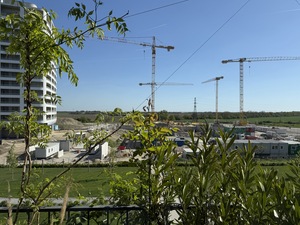
When we moved to this neighbourhood 6 years ago, ours was the last row of houses on the outskirts of Bratislava. Beneath our windows stretched fields, and overgrown land that provided shelter for a variety of species—from rabbits and countless insects to bird species that favour thickets and urban fringes, such as pheasants, tits, sparrows, thrushes, and especially crested larks (Galerida cristata) with their characteristic repetitive call. The crested larks prefer these kinds of transitional zones and move with them—resulting in the fact that their habitat in Slovakia has declined over the last couple of years and they are now among near-threatened species.
Five years ago, the neighbourhood began to be redeveloped—first into a public park with ample recreational facilities; later, construction of high-rise apartments began. The acoustic environment changed rapidly.
During the day, human activity dominates: playground sounds mixing with heavy construction. At night, non-human life emerges—what remains of it, as best it can.The pulsating non-human soundscape is being pushed farther and farther away as the city continues to expand. What you can hear in the mornings and at night are distant calls coming from a handful of shrubs and patches of vegetation that still remain standing hundreds of metres away, along with the far-off sounds of passing cars from the motorways that encircle the southern edge of the city, about 1.5–2 km away.
The soundscape will likely grow richer again over the next few years, as construction comes to an end and stops driving nesting species away, and as the vegetation planted in the park matures. For now, though, we are in limbo.