Live stream: mobile_amiskwaciywaskahikan.mp3
amiskwaciy-wâskahikan (Edmonton, Alberta, Canada)
Leslie Sharpe
Latitude: +53.52865°
Longitude: -113.55225°
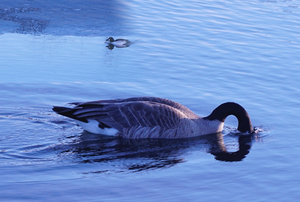
Streaming from an urban lake in amiskwacîwâskahikan / Edmonton, Métis Nation of Alberta Region 4. Sounds of recently returned geese and ducks splashing in the ice and water, pileated and downy woodpeckers, robins, waxwings and chickadees in the forest behind, and possibly a splash from muskrats and warbles of frogs. Streamed by Sharpe & MacDonald.
Listening to the land supports land acknowledgement – first of the Indigenous peoples who have lived and passed through here since long before colonial settlement, and second of the other lifeforms in this place. We’re streaming from Amiskwacî Wâskahikan (Beaver Hills House in Cree, so-called Edmonton).
We are streaming from a lake in this urban park on Treaty 6 Territory in Amiskwaciy Wâskahikan (Edmonton), Alberta. This lake is the summer home of a community of Canadian Geese, and edges forest paths that look over kisiskâciwanisîpiy, the North Saskatchewan River. Kisiskâciwanisîpiy starts from the Saskatchewan glacier in the Rocky mountains and joins other tributaries until it finally flows into Asiujarjuaq (Hudson Bay). Kisiskâciwanisîpiy has long been a meeting place and traveling route for the numerous indigenous peoples who have lived here for thousands of years, including Cree, Saulteaux, Blackfoot, Métis, Dene, and Nakota Sioux people.
In 1883, this site became River Lot 1 in the Métis river-lot system and was used to operate a gold-mining scow. The area was purchased and slated for development in the early 1900s, then used as a gravel pit, and finally was opened as a park for public use until a closure in 2023. Recently reopened for human use, the park never stopped being a home for bird that have migrated and settled here for thousands of years. Urban and colonial development and anthropogenic climate change have forced many migratory birds to change their routes and breeding sites, and many Canada Geese now return yearly to urban sites such as this one. Frequently city-dwellers see the geese and other urban wildlife here (such as coyotes, beaver, and porcupines) as an encroachment and problem despite constant urban development that encroaches upon natural habitats for these and other species. Cities address the geese in their rhetoric as a ‘problem’ rather than challenge city- and suburb- dwellers to accept that they might be the problem, expecting wildlife to change its ways or places of being or be moved.